HomeInfra
👋 Welcome to my home infrastructure!
This is a high-level overview of the platform I run at home — the network edge, the compute and storage layers, and the services on top of them. It is deliberately kept free of internal addressing and hostnames; the detailed operational documentation lives on an internal docs site.
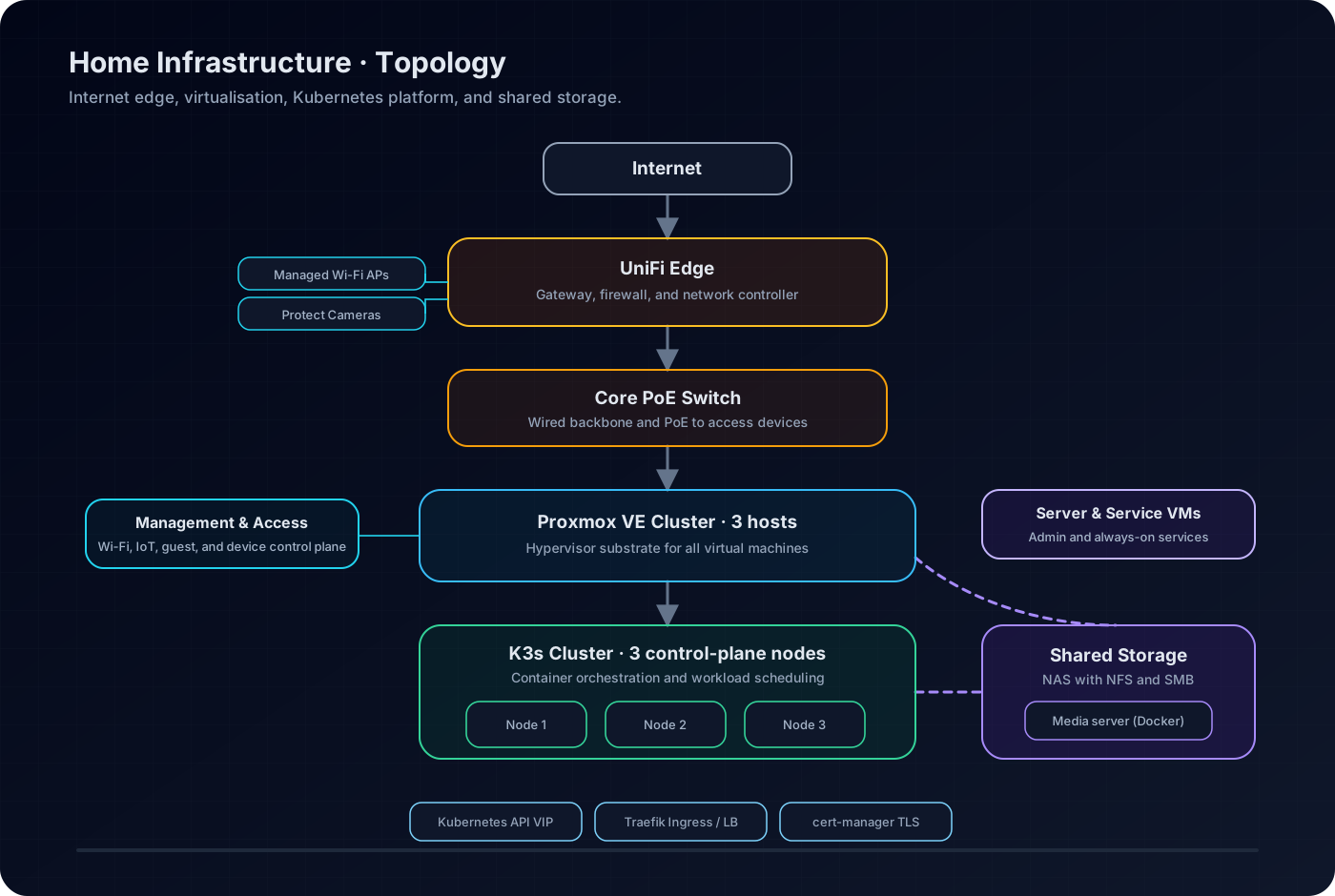
High-level topology: UniFi edge, Proxmox VE, K3s, and shared storage.
At a Glance
| Area | Platform |
|---|---|
| Network edge | UniFi Dream Machine Pro |
| Switching | UniFi 16-port PoE switch |
| Wireless | UniFi managed access points |
| Virtualization | 3-node Proxmox VE cluster |
| Kubernetes | 3-node K3s cluster |
| Shared storage | TrueNAS (NFS, SMB) |
| GitOps delivery | ArgoCD |
| Ingress & TLS | Traefik with cert-manager |
| Secrets management | HashiCorp Vault |
Design Principles
- Segmented by purpose. Management, cluster, and server traffic each live on their own network segment, with Wi-Fi SSIDs mapped to the appropriate segment.
- Everything as code. Workloads and their configuration are described declaratively and delivered through GitOps flows.
- Separate storage tier. Bulk and shared storage is centralised on a dedicated NAS rather than spread across the compute hosts.
- Redundancy where it earns its keep. The hypervisor and Kubernetes layers both run as three-node clusters so a single host loss is not an outage.
Platform Layers
Network edge and access
- Gateway / controller: UniFi Dream Machine Pro handling routing, firewalling, and the UniFi control plane.
- Core switching: a UniFi 16-port PoE switch acting as the aggregation point and powering the access points.
- Wireless: UniFi-managed networks for primary, IoT, and guest access.
- Physical security: UniFi Protect cameras around the property.
Compute and orchestration
- Hypervisor layer: three Proxmox VE hosts with mixed local storage and RAM configurations.
- Cluster workload layer: a three-node K3s cluster, each node running as a VM on a separate Proxmox host for failure isolation.
- Service exposure: Traefik-based ingress with automated certificates, fronted by load-balancer VIPs for the API and ingress endpoints.
Storage
- Primary storage system: a dedicated TrueNAS server providing shared file services.
- Protocols in use: NFS for infrastructure and Kubernetes consumers, SMB for general data access.
- Media hosting: Plex runs directly on the storage platform as a Docker container.
- Kubernetes storage: Longhorn provides replicated block storage for stateful workloads, with a local-path class for ephemeral data and an NFS-backed class for shared volumes.
Platform Services
The Kubernetes cluster runs on a standard platform stack:
- Traefik (default ingress class)
- cert-manager for TLS lifecycle
- Longhorn for replicated persistent volumes
- MetalLB for load-balancer IPs
- ArgoCD for GitOps delivery
- Rancher for cluster management
- HashiCorp Vault for secrets
- CoreDNS, Metrics Server, and the local path / NFS storage provisioners
Hosted Workloads
Alongside the platform services, the cluster hosts:
- Documentation platform — an internally published MkDocs-based reference for this infrastructure.
- Cluster management UI — day-to-day Kubernetes administration.
- Secrets management — Vault-backed secret storage.
- Password manager — self-hosted vault for personal credentials.
- Media automation and streaming — request, download, and library management integrated with the NAS media store.
- Dynamic DNS automation — keeps public DNS records pointed at the current WAN address.
Operations
Keeping the platform healthy is mostly a matter of routine checks:
- Frequently: gateway and internet health, critical app availability, Kubernetes node readiness, NAS pool alerts.
- Weekly: backup job results, cluster resource consumption, disk growth, pending updates.
- Monthly: test-restore at least one critical workload, review firewall exposure and certificate expirations, validate power-failure procedures.
Note
Detailed runbooks, network topology, and the full hardware inventory are maintained on a separate internal documentation site and are intentionally not published here.
Last updated on